
Montessori Material Spotlight: The Bead Cabinet
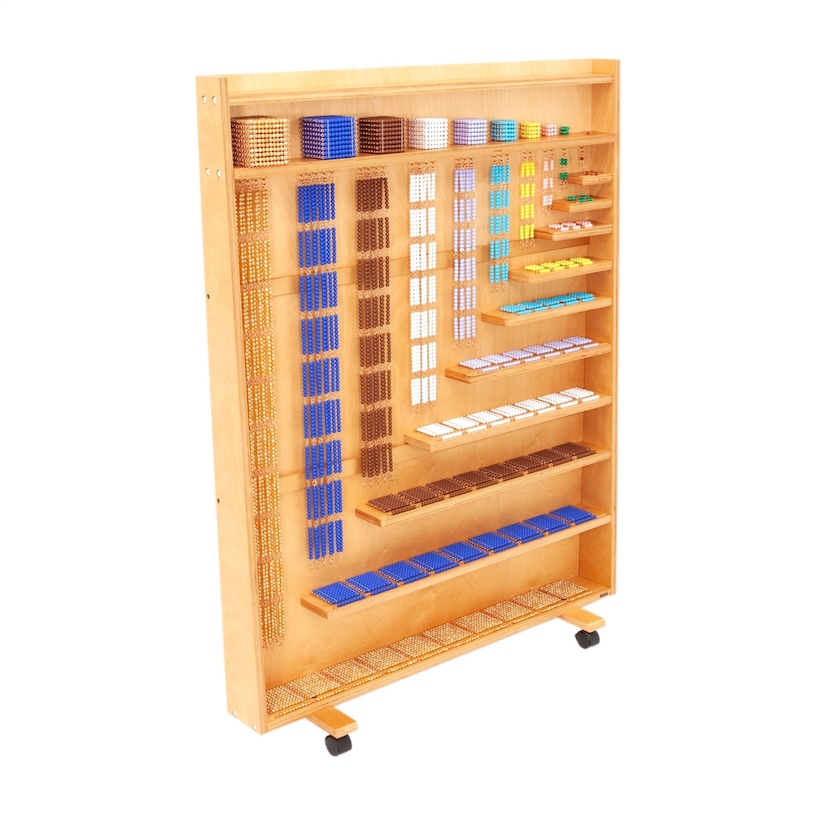 In any Montessori classroom, the vibrant bead chains are hard to miss—and for good reason. These colorful, tactile materials are a cornerstone of Montessori math, helping children move from concrete understanding to abstract thinking across multiple developmental stages.
The Bead Cabinet is not just one material, but a system that grows with the child, supporting increasingly complex mathematical concepts over many years.
What is a bead cabinet?
The Bead Cabinet contains a series of short and long bead chains, each color-coded to represent different numbers. These chains allow children to physically build, count, and explore numerical relationships.
Unlike worksheets or memorization-based tools, bead chains invite children to touch math, see patterns, and discover relationships independently. This aligns with the Montessori belief that children learn best when they can actively engage with materials rather than passively receive information.
How the Bead Cabinet Supports Math Learning at Every Stage
Primary (Ages 3–6): Building the Foundation
In the primary classroom, bead chains help children develop early number sense through:
- Counting and one-to-one correspondence
- Skip counting
- Understanding teen numbers
- Early place value concepts
Children begin to recognize patterns in numbers and develop a concrete understanding of tens, hundreds, and thousands. This foundational work prepares them for later mathematical thinking without pressure or abstraction.
At this stage, the emphasis is not speed or memorization, but confidence and familiarity with numbers.
Lower Elementary (Ages 6–9): Expanding Number Sense
As children move into lower elementary, bead chains take on new meaning. They are used to:
- Explore multiplication
- Practice skip counting in more complex sequences
- Discover common multiples
- Identify numerical patterns
Through repeated hands-on work, children begin to internalize how numbers relate to one another. This prepares them for fraction work and more advanced operations later on.
Rather than being told how math works, children experience it for themselves—building both understanding and independence.
Upper Elementary (Ages 9–12): Abstract Thinking Made Concrete
In upper elementary, the Bead Cabinet becomes a bridge to higher-level mathematical thinking. Students use the chains to explore:
- Squaring and cubing
- Square and cube roots
- Exponential growth and numerical relationships
By physically working with short and long chains, students can see and feel mathematical relationships that are often taught abstractly in traditional classrooms.
The Result: A Deep Understanding of Math
The Bead Cabinet is a beautiful example of how Montessori materials are designed to grow alongside the child. From early counting to advanced operations, it supports learning across many years—deepening understanding rather than replacing it.
By engaging the hands, mind, and curiosity of the child, the Bead Cabinet helps foster not only mathematical skill, but confidence, independence, and a lifelong love of learning.